The Campaign Slut has returned from the November Executive Board meeting of the California Democratic Party, a mercifully short drive from the San Francisco airport this time, inspired and hopeful and ready to campaign on.
What could have been two contentious items involving strongly held views by passionate Democrats were averted, one by being pulled, the other by being referred to a thoughtful committee for further consideration by 2015. (Ask me, if you really need to know.)
So the 2014 election cycle is in full swing. We met candidates for Secretary of State, term limits ending the tenure of our beloved Debra Bowen. Three men, State Senators Alex Padilla and Leland Yee and Common Cause's Derek Cressman are vying for that seat. They spoke to the Progressive Caucus last night. Wish more people were there to listen. This is an important seat.
Friday night our Platform Committee took testimony and broke into smaller plank groups. We continue to fine tune the Preamble and got some good work done on my other planks, Death with Dignity and Energy and the Environment.
The Women's Caucus Saturday featured the Proposition 8 case plaintiffs Kris Perry and Sandy Stier who spoke of the importance in getting involved in issues we care about early, so that we can keep bad propositions like Prop. 8 from happening in the first place and protect our hard-earned but never entirely safe, rights.
Then we got a special Campaign Boot Camp workshop on the 1965 Voting Rights Act which the Supreme Court is busily gutting with newly enacted voter ID laws, meant to disenfranchise old people, students and anyone of color.
Lots of schmoozing in the bar, in the lobby, in between meetings and general sessions. Jan Black and I met a fascinating Polish gentleman on his first trip to the States, to give a training for the local office of the large investment firm he works for. We talked politics, American and Polish, including Party make up and health care. His English was excellent. He says people in Poland learn English with a British accent. We exchanged contact info, and Jan on her international travels, already plans to meet up with him and his wife in Chile the first of the year.
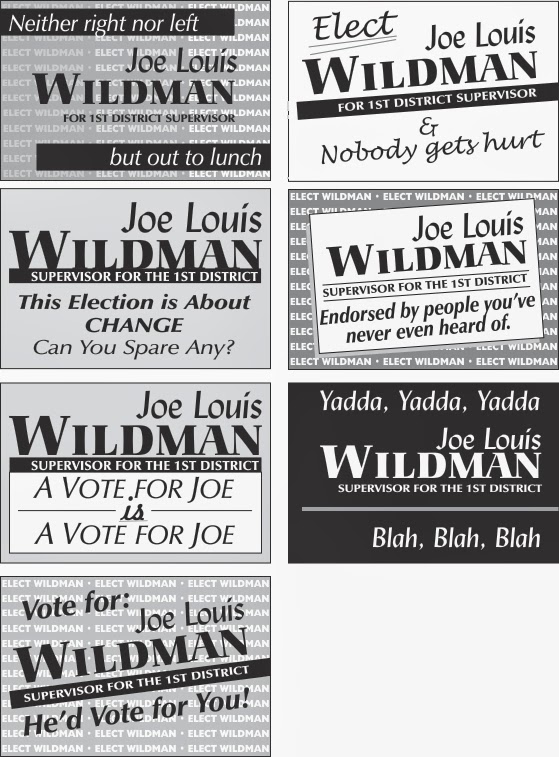
The most fun was having political wizard Joe Louis Wildman, who has the most wicked sense
of humor in all the good ways, share his strategy for a 1996 supervisorial race
comprised entirely of slogans in weekly ads in the Anderson Valley Advertiser. He lost, but the Campaign Quips live on. A sample printed here, courtesy of designer Sonia Taylor. Enjoy. They may inspire your own future campaigns!
Cooking up a campaign? Need a new recipe? You've come to the right place! The Campaign Cookbook offers tips to season your campaign, make the dough rise, and be prepared for when it gets hot in the electoral kitchen. Recipes tried and true, and innovative too, presented by GreenDog Campaigns. www.greendogcampaigns.com
Sunday, November 24, 2013
Tuesday, November 19, 2013
A Few Words About Endorsements
Everybody wants them. Everybody says you have to have them. The person with the most doesn't necessarily win. What's all the fuss about endorsements anyway?
Here's a hint: It's the quality, not the quantity of endorsers that can make the difference. Yes, your friends and neighbors are important. It's good to show that people you know, ordinary voters, like you. But that long list of names most people never heard of is only impressive to the few who know them well and respect their opinions. And those few may never see that their neighbor Joe Schmo supports you, if Joe's name is just one in a sea of names occupying valuable real estate on the back of your mailer.
So what endorsements count? There are roughly three categories: Organizations, elected officials and opinion leaders.
Organizations:
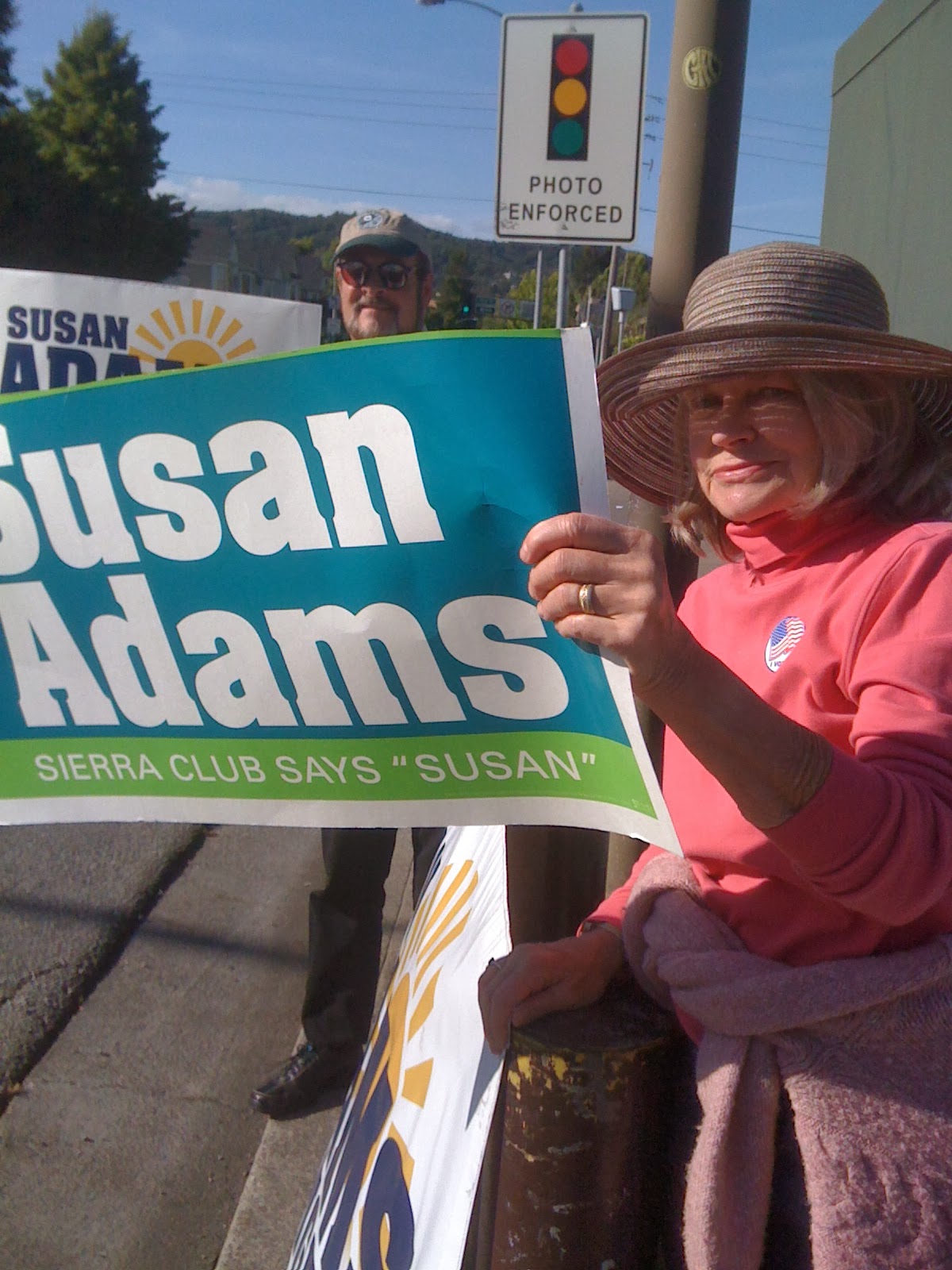
Certain organizational endorsements are heavily sought by candidates depending on what issues are important to the electorate. The Sierra Club is key if you want to clue in environmentalists and nature lovers that you are the one who will stand up to conserve wetlands, open space or urban parks.
Nurses imply integrity and compassion. Teachers show that you care about the next generation and the quality of their education, even if education isn't a top priority in your race.
Business and development organizations say you may be open to new growth and growing the economy.
Firefighters and police show you are trusted to keep your community safe.
Think about what each organization wants in a candidate and make sure you meet those criteria when seeking the endorsement. Then use the logo of the organization (or newspaper - these also can be important in local as well as larger elections - but caveat - make sure it's ok with the organization to use their logo on your materials. The Sierra Club for instance has a specific logo just for their endorsed candidates to use. Newspapers generally don't let their trademarked materials be used) proudly on your material. If you can get a quote from a leader of the group stating that you are the one who will carry their priorities forward, that's a big plus.
Elected officials:
See if your Congressmember, State Senator or local city council person will endorse you. People who are held in high regard because of their positions will count the most. Those who hold similar positions to the one you are running for are also key. Do the members of the school board you are running for support you? Get a quote from the President of the board on why you would make a good member. Use their photo alongside their testimonial. This will stand out to the voter a lot more than just listing them in a long queue.
Opinion leaders:
These are people whose opinions matter. They may be heads of community organization, homeowners associations, or environmental or civic groups. Attractive pictures of these people, alongside a quote about your superior ability to hold the position you seek will be seen, read and remembered by the voters.
Put a few of these together in a single mailer or precinct handout, and you have a strong testimonial piece.
As for the long list of all the wonderful, yet unknown people who endorse you? That belongs on your website. Make sure there is a reference to it in your mail and a note to see a "complete list of endorsers" there. No one will be insulted that they didn't make your flyer. A true endorser wants you to win, not see their name in print.Wednesday, November 13, 2013
You lost, What Now?
Don't despair. You put yourself out there and ran a good race. I've been there myself, many times. It can be demoralizing, but it helps to pick yourself up and think about the next time.
First take a look at some of these contributing factors to losing races. Of course, sometimes you are just outspent or out-campaigned. (Running against an incumbent is especially hard, no matter how accomplished you are.) They may help in your next outing.
1. Did you have a consultant? A good consultant can help you position yourself by identifying key issues for you to distinguish yourself from the field, targeting voters, so you mail only to those most likely to vote in your election and creating a good image and message for you to use throughout the campaign. She can also help you see pitfalls and obstacles that you need to overcome.
2. Did you run against an incumbent and fail to tell the voters what he was doing wrong? It's hard to run against an incumbent. They have name recognition and that all-important "I" beside their name on the ballot. You need to tell the voters why they should fire him and hire you. If there's no problem, it will be that much harder to win, without spending a lot more money and doing some "out of the box" thinking.
In a first time college board race for an unknown in a race with three incumbents, our candidate did just that, she outspent the rest, pointed out the real issues that were keeping the school from being its best and made sure her message was heard, in mail, on TV and on the web. She came in first in a 5 way race.
3. Is your material too wordy? The old saying "A picture is worth a thousand words" works in politics too. Show, don't tell. People will not read your long list of accomplishments in paragraph format, but they will pay attention to eye-grabbing graphics, headlines and bullet points. Of course make sure everything you say is relevant and important enough to hold their attention until they get into the voting booth.
4. Did you spend your money on signs and bumper stickers, instead of another piece of mail or handouts for a few more precincts? Signs and other campaign "swag" are fine if you can afford them, but make sure you have the bases covered first. The voting public must see your name and attach it to your message several times before it sticks. Just having the most signs is not enough.
What you stand for, what you'll do for them, is what the voters want to know. Tell them, repeatedly, succinctly and graphically.
5. Did you make the most common mistake of all, not raising money? No one likes to ask for money. But remember without it, you will not be able to get your message to the voters. You don't need to have the most money, but you need enough to be viable. Practice with your friends and family, talk to other candidates who've run and won and start early, before the next race gets off the ground.
If you do these few simple things, you will be in a much better position the next time you run.
Candidate practicing her "Stump" speech
Wednesday, November 6, 2013
Post-Election Day Euphoria and Letdown
It's the day after election. You may have won; you may have lost. You may be kicking yourself for not sending out one last mailer or taking out one last ad, or doing one last precinct walk. Or you may be congratulating yourself for that late robo call, phone bank, GOTV effort and honk and wave at some prominent intersections.
will you ever know what exactly it was that made the difference? Proably not. But I bet the guy who got the City he was running in wrong is kicking himself up one side and down the other.
I bet the woman who decided she didn't need a consultant because she had experience volunteering on other people's campaigns is thinking twice. I bet the guy who thought more words and fewer graphics on his mail would do the trick is still pondering why the voters failed to get his message, and I'm sure the woman who felt fundraising was not necessary because "everyone knows me in my town," is wishing she'd listened to her advisers a little more.
All may not be lost in some races, however. I know of two recent instances where a candidate, down on election night, made up the difference and then some to win when the last late absentee ballots were counted.
If less than a percentage point separates you and you did well among the voters on election day, and you campaigned up until the last minute, there is still hope. The numbers of people who turn their absentee ballots in at the polls are increasing every year. Wait until the last vote is counted (usually about two weeks after Election Day), and you may still be a winner.
Monday, November 4, 2013
Vote like your Rights Depend on it - They do!
We take a break from the Campaign Tip of the Day series to bring you something from the "You can't make this stuff up" department.
90 year old former House Speaker Jim Wright was told "No vote for you!" because, even though he had voted in every election since 1944, he was turned away for a Texas ID card, which is now required by draconian voters suppression laws in that state. Why? His driver's license had expired in 2010 and he failed to bring a birth certificate to the agency issuing IDs.
If this can happen to someone with credentials like Wright's, think of all the people lacking sufficient proof of their existence, like elders in nursing homes and people whose births may have been unrecorded due to being born at home, our of wedlock, in poverty, or those who lack the wherewithal to procure the necessary paperwork.
Wright plans to return with the necessary documentation in time to vote in the upcoming election. Not everyone is so savvy or so lucky. Bad portent for the future.
Read the article here.
Saturday, November 2, 2013
Campaign Tip of the Day - Proof your Mailings!
In a strange twist for someone who ought to know better, a candidate for a local Town Council seat sent out a mailer with a headline reading that he was running for a seat on a different Council altogether in another town!
How does this happen? He claimed the error was the fault of the printer. He wanted the mail to get out fast as election day was near and did not have time to proof it.
Really? I always proof my mail before it goes to the printer, then again, before it is printed. Yes, typos and misspellings have been known to occur, but this is the first time I've heard of a mailer going out for a completely different seat in a different town. If he didn't have enough time, he should have designated a trusted staff or volunteer to do the proofing. Printers don't generally create the mail, they just print what is sent to them by the campaign.
Well, live and learn, as they say. Here's the story with the erroneous mailer on display:
Burdo,
who works as a public affairs consultant with Kathleen Russell
Consulting, is one of three candidates competing in Tuesday's election
to fill the two-year opening on the San Anselmo Town Council. The other
two candidates are Doug Kelly, who sells computerized point-of-sale
systems, and Matt Brown, owner of Meridian Commercial, a real estate
brokerage.
Burdo said the mailer error occurred because the printer neglected to send him a proof of the design before printing and mailing it.
"The protocol for printing is that they put it in on the press, they develop a proof and then they email you the proof for approval, and you say thumbs up or thumbs down," Burdo said. "That never happened in this case."
Burdo said he wanted the mailer to go out as soon as possible so the printer was rushing to finish the job. Burdo, who worked on the campaign of San Anselmo Councilman Ford Greene, said he has never had a mistake like this occur with a client.
"It's very ironic that it happens during mine," he said.
Read more by clicking on the headline above.
How does this happen? He claimed the error was the fault of the printer. He wanted the mail to get out fast as election day was near and did not have time to proof it.
Really? I always proof my mail before it goes to the printer, then again, before it is printed. Yes, typos and misspellings have been known to occur, but this is the first time I've heard of a mailer going out for a completely different seat in a different town. If he didn't have enough time, he should have designated a trusted staff or volunteer to do the proofing. Printers don't generally create the mail, they just print what is sent to them by the campaign.
Well, live and learn, as they say. Here's the story with the erroneous mailer on display:
Right race, wrong town: Marin council hopeful sends botched mailer
Posted:
11/01/2013 06:31:25 PM PDT
A
candidate for San Anselmo Town Council who works as a campaign
consultant sent out a mailer last week that accidentally read: "Please
join us in supporting Steve Burdo for Larkspur City Council."
Burdo said the mailer error occurred because the printer neglected to send him a proof of the design before printing and mailing it.
"The protocol for printing is that they put it in on the press, they develop a proof and then they email you the proof for approval, and you say thumbs up or thumbs down," Burdo said. "That never happened in this case."
Burdo said he wanted the mailer to go out as soon as possible so the printer was rushing to finish the job. Burdo, who worked on the campaign of San Anselmo Councilman Ford Greene, said he has never had a mistake like this occur with a client.
"It's very ironic that it happens during mine," he said.
Read more by clicking on the headline above.
Wednesday, October 30, 2013
Campaign Tip of the Day - Start Early
It's not too early to be thinking of your 2014 race. Will you run for City Council, School Board, County Supervisor or something higher the food chain? Filing for the June primary will be here soon, especially if you are thinking of collecting signatures in lieu of the fee. Even if your race isn't until November, think about the budget, the issues and how you think you will present yourself to voters.
Start raising money. Especially for the big-ticket races, Assembly, Senate, Congress. If it's an open seat you won't be the only one eying the race. So start locking up those endorsers - and donors - soon.
Subscribe to:
Posts (Atom)